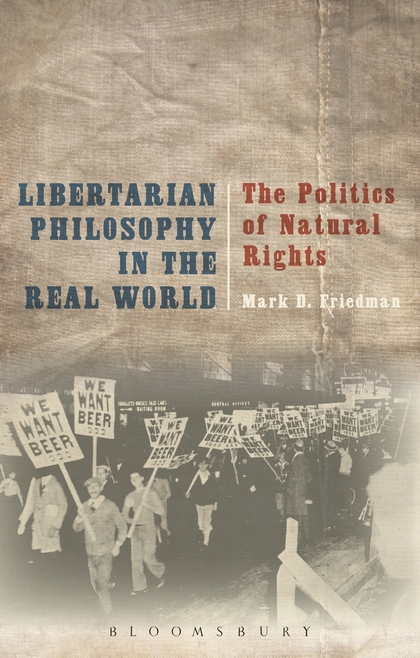
Libertarian Philosophy in the Real World: The Politics of Natural Rights
 (Now Available)
Nozick’s Libertarian Project: An Elaboration and Defense
The Best of Modern Swedish Art Glass: Orrefors and Kosta 1930-1970
Author Archives: Mark Friedman
Nozick’s Experience Machine: Not Broken
Depending on one’s perspective, one of the joys (or frustrations) of reading Nozick is his unique style. As Matt Zwolinski recently wrote in reviewing The Cambridge Companion to Nozick’s Anarchy, State, and Utopia, (Bader and Meadowcroft eds): “One cannot read too far in it without coming across an idea that is brilliant, fecund, intriguing . . . and dropped almost as soon as it is introduced. Whole books, if not whole academic careers, could be devoted to working out in detail the ideas that Nozick relegates to mere footnotes and asides.” One supposed example of Nozick’s tendency in this regard is his thought experiment involving the “experience machine” (see ASU, 42-5).
This apparent digression has been the subject of extensive analysis and discussion in the literature, and is thus the subject of one of the essays comprising The Cambridge Companion, Fred Feldman’s “What We Learn From the Experience Machine,” at 59-86. I will cut to the chase, and simply say that Feldman’s contribution represents a classic case of not being able to see the forest for the trees. More explicitly, while he correctly identifies what this imaginary case is not about, he misses its point entirely. Continue Reading »
Posted in Blog
4 Comments
Libertarianism, Safety Nets, and Ideal Theory
The purpose of this post is to emphasize a problem in our thinking about social safety nets that I believe is often ignored. Virtually all non-libertarians, and even most minimal state libertarian philosophers, will endorse the following: “If a state social welfare program, funded by coercive taxation, is both a necessary and sufficient means of preventing grave harm to the welfare of innocent persons, its implementation is morally justified” (“Proposition #1”). Continue Reading »
Posted in Blog
9 Comments
Arneson vs. Nozick on Libertarian Rights
This is the third in an ongoing series of commentaries on the essays in The Cambridge Companion to Nozick’s “Anarchy, State, and Utopia,” Bader and Meadowcroft eds. In this post, I will analyze Richard Arneson’s contribution, “Side Constraints, Lockean Individual Rights, and the Moral Basis of Libertarianism.” For reasons that will soon become clear, I found this essay rather disappointing. Continue Reading »
Posted in Blog
Leave a comment
Democratic Slavery
Natural rights libertarians hate coercion, particularly when employed by the most powerful and dangerous entity of all, i.e. the state. We despise it because it robs us of the moral discretion that is the birthright of every competent adult. It can be justified only in very narrow circumstances, as argued here: http://naturalrightslibertarian.com/natural-rights-libertarianism/ and here: http://naturalrightslibertarian.com/2012/10/justifying-the-minimal-state-part-ii/. The fact that this coercion is administered by officials elected by a majority of our fellow citizens is irrelevant from the moral point of view. Continue Reading »
Posted in Blog
3 Comments
Has Nozick Failed to Give Us Utopia?
This is the second in a series of commentaries on the essays in The Cambridge Companion to Nozick’s “Anarchy, State, and Utopia,” Bader and Meadowcroft eds. My first review is here: http://naturalrightslibertarian.com/2012/10/justifying-the-minimal-state-part-ii/ . In this post, I will analyze Chandran Kukathas’s contribution, “E Pluribus Plurum or, How Not to Get to Utopia in Spite of Really Trying.” While Prof. Kukathas provides a useful exegesis of Nozick’s libertarian conception of utopia, along with a number of interesting observations, I do not believe that his critique lands any substantive blows against it. Continue Reading »
Posted in Blog
2 Comments
Why Liberal Democracies Fail
We are currently witnessing the implosion of Greek society: basic goods and services are becoming scare, essential governmental functions are grossly neglected, and law and order is breaking down. This situation is deeply ironic given that Greece is the birthplace of democracy, and should cause us to wonder how such a thing can occur. This question is especially urgent because Greece is not only a first world, liberal democracy, but almost certainly not a special or isolated case. Rather, most probably, it is the first in a chain of falling dominoes all built on the same social model. Continue Reading »
Posted in Blog
11 Comments
Libertarians and Foreign Policy, Part II
I have previously argued against the existence of a doctrinaire libertarian foreign policy stance in favor of non-interventionism or isolationism (http://naturalrightslibertarian.com/2011/09/natural-rights-libertarianism-and-foreign-policy/), and intend to return to this topic in a subsequent post. For the moment, however, I wish to examine a view that, while not purportedly compelled by any libertarian axiom, is nevertheless extremely popular in libertarian circles. It is promoted by Ron Paul, the Cato Institute, the Ludwig von Mises Institute, and is an article of faith for a majority of libertarians. This argument holds that virtually all military action beyond the actual defense of the homeland, including humanitarian interventions, the maintenance of alliances, and the use of military bases, is unwise because “when our government meddles around the world, it can stir up hornet’s nests and thereby jeopardize the safety of the American people.” Ron Paul, The Revolution: A Manifesto, p.19. Continue Reading »
Posted in Blog
Leave a comment
Justifying the Minimal State, Part II
Almost from the moment that Anarchy, State, and Utopia was published, its critics, particularly the individual anarchists, have attacked Nozick’s proffered moral justification for the coercion employed by (even) the minimal state, i.e. one devoted almost exclusively to the protection of its citizens from foreign and domestic predators. From the anarchist perspective, the fatal flaw in the minimal state is that it forces unwilling parties to forgo the enforcement of their own rights, and to entrust this function to a central authority. For the reasons set forth in Chapter 4 of my Nozick’s Libertarian Project (“NLP”), I concur with these objections.
In this same chapter I offer an alternative defense of the minimal state, based on what I call the “libertarian principle of fairness” (NLP, 96), i.e. “that if the benefits and burdens of cooperating with the state in a program necessary to secure our rational agency are fairly distributed, then all rational agents are morally obligated to participate.” Most basically, with respect to those functions of the state that establish the preconditions for the exercise of our moral agency, it is simply unfair for some members of a community to reap the benefits of the efforts of others while refusing to contribute themselves. I apply this principle to the coercive funding of national defense here: http://naturalrightslibertarian.com/2011/02/can-the-minimal-state-be-justified/.
In his essay titled “Nozickian Arguments for the More-Than-Minimal State” in the recently published The Cambridge Companion to Nozick’s “Anarchy, State, and Utopia,” Bader and Meadowcroft eds. (“CCN”), Eric Mack (a respected and widely-published libertarian philosopher) takes on this same subject. This post will analyze Professor Mack’s strategy, and will compare it in certain respects to my own humble efforts. Continue Reading »
Posted in Blog
21 Comments
Must Libertarians Be Cosmopolitan?
In the language of political philosophy “moral cosmopolitanism” is the view that the interests of all persons, wherever located, are entitled to equal weight, and thus we have no justification for favoring the economic or other interests of our fellow citizens: http://plato.stanford.edu/entries/cosmopolitanism/. There are versions of this doctrine, “moderate cosmopolitanism,” that allow for some local favoritism. It is easy to see how this perspective can be derived from utilitarianism, which requires the agent to impartially weigh the happiness of all persons. Continue Reading »
Posted in Blog
Leave a comment
In Praise of Political Gridlock
The public airwaves are filled these days with cries of anguish and stinging criticism of the two major political parties’ failure to break the existing deadlock regarding tax rates, federal spending, entitlement reform, and related issues. This essay will argue that such denunciations are, for the most part, misplaced, and based on a failure to appreciate the reasons for this stalemate. Of course, there is nothing inherently praiseworthy about gridlock, but there are times, like the present, when it is unobjectionable if not actually commendable. Continue Reading »
Posted in Blog
2 Comments