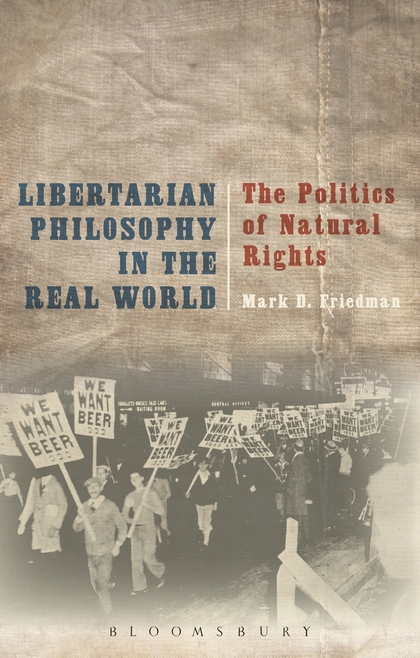
Libertarian Philosophy in the Real World: The Politics of Natural Rights
 (Now Available)
Nozick’s Libertarian Project: An Elaboration and Defense
The Best of Modern Swedish Art Glass: Orrefors and Kosta 1930-1970
Author Archives: Mark Friedman
Free Speech: Again, Misunderstood and Underappreciated
As some of you know by now, I have taken time away from my libertarian-minded commentary to focus on my Jewish theology blog. Nevertheless, when I encounter an influential public figure such as Josh Hammer writing something that impugns the absolute (apart from unrealistic philosophical thought experiments) value I assign to free expression, the temptation to reply becomes too powerful to resist. As I (following Nozick) argue in chapter three of my Libertarian Philosophy in the Real World, the paramount value of human life rests on our “rational agency;” that is, the Kantian notion of persons as responsible moral agents. Continue Reading »
The Iran Protests and Humanitarian Interventions
Many years ago I posted an essay on this site that challenged the sharp distinction many libertarians make between military interventions based solely on a state’s obligation to defend its citizens against aggression and “humanitarian” interventions, i.e. those intended to defend non-citizens in other states (think Rwanda). While a state is morally obligated to defend its own citizens against unprovoked attack, aggression against other states may still implicate our rights. Accordingly, depending on the circumstances a humanitarian intervention may still be morally permissible on libertarian grounds.
The current protests in Iran seem to present such a case, and thus I believe it timely to re-post my 2017 essay. Comments are of course always welcome.
Calling Ayn Rand!
As evidenced by the recent election of avowed socialists as mayors of NYC and Seattle, the cumulative failures of our education system and the mass media’s and academia’s intense hatred of free markets seem to have reignited an infatuation with socialism. Accordingly, this may be an appropriate moment to repost my essay regarding Ayn Rand, presented here some eleven years ago. As stated there, while I do not believe her Objectivism to be a cogent moral philosophy, I certainly admire her for being one of the first intellectuals to warn the West regarding the horrors of communism.
Moreover, I praised her for being an acute observer of human psychology, and diagnosing the motivations underlying humanity’s attraction to collectivism. To quote from my essay:
Nevertheless, Atlas Shrugged is a compelling read, and I believe that the key to its enduring success is Rand’s keen understanding of human psychology as expressed in the political realm. I believe that the key to the novel’s appeal is the author’s skill in graphically depicting how a society can implode when it fails to internalize the “meta-legal doctrine” that Hayek refers to as the rule of law. See The Constitution of Liberty, chapter 10. In a nutshell, Hayek’s political ideal requires the state to maintain strict neutrality between different groups of citizens, acting only to establish and enforce the “rules of the road” that all members of the community can use to guide them in pursuing their individual projects.
When, instead, citizens view the state not as a neutral referee but as a vehicle for redistributing wealth, they can be blinded by the authorities regarding the extent to which government’s own policies have impoverished them, both materially and morally. They will develop habits of mind that incline them to see the successful entrepreneur not as a precious asset, responsible for enriching society and creating opportunities for others, but as a source of plunder to be taken for the “greater good.” As illustrated in Atlas, this envy will in turn lead to governmental interventions that discourage entrepreneurship, and when taken to the extreme, kill it.
With our younger voters so afflicted, I fear dangerous times ahead.
Posted in Blog
Tagged atlas shrugged, ayn rand, collectivism, communism, libertarianism, Mamdani, objectivism, socialism
Leave a comment
Turning from Political Philosophy to Jewish Theology
As some of you may know, I have let this site go dormant as I completed writing and now seek to promote my book, Come Now, Let Us Reason Together: Uncovering the Torah’s Liberal Values (Wipf and Stock, 2025). The book is available on Amazon and the other usual suspects. If interested, my publisher is having a 50% off sale, with free media mail shipping at its website, using the code “CONFSHIP.” Since I am using “liberal” in the title in its original classic meaning and not its present sense, these two subjects may more related than they first appear.
You are also invited to visit my new website and my related FB page. You may also visit me on X, where my handle is @RightsGuy1953. I may still occasionally post here on libertarian philosophy.
Posted in Blog
Tagged authentic Judaism, egalitarian Judaism, liberal Judaism, pluralistic Judaism, Rabbinic Judaism, Talmud, Torah
Leave a comment
The Wages of Mediocrity
The rejection of meritocracy in favor of skin color diversity has long been a core principle of leftist ideology. This started in the 1960s with the advent of “affirmative action” in our colleges and universities, and ultimately metastasized into the realm of government contracting and university hiring, liberal judges mistaking disparate impact for illegal discrimination, and into the selection of political appointees and nominees. Although few ordinary people would select a person to design their dream home or a brain surgeon based on their skin color, this commonsense did not deter our progressive politicians.
From this perspective, President Biden’s rise and fall is so thick with irony, that you can cut it with a knife. Biden’s long public life prior to his election to the presidency is nothing if not mediocre. It was preceded by academic career that was spectacularly undistinguished, and in his 36 years in the US Senate he articulated no new or innovative ideas, nor is he associated with any notable legislation. His hostile questioning of Supreme Court nominee Clarence Thomas was embarrassing both for its ugly tone and its ineptness. Continue Reading »
Posted in Blog
Leave a comment
The Shameful “Open Air Prison” Lie
[NOTE: I accuse the authors of the article discussed below of lying. Clearly, I cannot know whether they are guilty of a conscious effort to deceive, but their erroneous allegations have all the appropriate indicia. For one, I find it incredible that two well-educated people who consider themselves knowledgeable enough to write on this subject do not understand that Egypt has an eight-mile border with Gaza, nor how critical this fact is to a proper understanding of this subject. Second, I called these authors out on their errors on a mutual friend’s Facebook page, and they did not correct any of them or even respond. I will let my readers judge for themselves].
Apart from the “apartheid” lie, it seems that the most popular one circulating about the Israeli-Palestinian conflict is that Israel is inflicting unbearable suffering on the people of the Gaza Strip by turning it into the world’s largest open-air prison. Here is a classic example, written by two purported libertarians/classic liberals, Akiva Malamet and Shikha Dalmia, made even more egregious by its timing. That is, in the immediate aftermath of the monstrous, massive terrorist slaughter committed by Hamas in central Israel on October 7, 2023 for which many faculty members and students at our elite universities offer excuses.
Here, in stark terms, is this hideous lie:
But if Hamas emerged and, what is more, flourished, it cannot be denied that this is at least partly because of Israel’s cruel 16-year-long blockade of Gaza and the brutal occupation of the West Bank….to prevent Gaza from militarizing after Hamas came into power, Israel sharply constrained the flow of people and goods between Gaza, territorial Israel and the West Bank, turning the spigot of free movement on and off at its discretion. Since 2007, the two million Palestinians in the 365 square kilometer Gaza strip have been subjected to an air, land, and sea embargo with only the minimum entry of goods allowed. Exports have nearly stopped. Meanwhile, Israel supervises all the international aid to Gaza….Hamas’s meticulously planned attack has exposed the spectacular failure of this approach to national security. But this approach has succeeded in turning Gaza, which many have appropriately compared to an open air prison, into one of the poorest societies on earth (my emphasis).
Posted in Blog
2 Comments
Market Discipline vs. Government Regulation in Banking
As explained here, when a community or nation enforces some rough approximation of the rule of law, capitalism inevitably follows. When left alone, entrepreneurs will invest and/or produce in order to improve their own lives, and in so doing will benefit those who purchase the goods and services they offer. Whatever its moral virtues, a system of free markets would understandably have very few supporters if it were economically inferior to competing political economies. Fortunately, capitalism is better at both preserving rights and producing the “greatest good for the greatest number.”
It does this (ideally) by means of the efficient allocation of capital and by promoting fierce competition for consumer dollars, forcing producers to continuously drive down prices and to improve quality over time, or lose market share to firms that do. Another way to express this is the term “market discipline.” It is easy to list once dominant corporations that were humbled or driven out of business by firms that created better business models or innovated new technologies: Sears Roebuck, Compaq Computers, Kodak, Polaroid, Circuit City, Pan American Airlines, Blockbuster, etc. Of course, the state obstructs and corrupts this salubrious discipline when it arbitrarily confers advantages on some market participants and handicaps others, or when it creates a “moral hazard” by subsidizing irresponsible behaviors.
As you must know, we are now facing severe loss of confidence if not an outright crisis in our banking system, with dangerous economic spillover effects, following the failure of Silicon Valley Bank and Signature Bridge Bank, and the potential failure of Republic Bank. Notably, since the advent of federal deposit insurance on January 1, 1934, market discipline has largely been eliminated from our banking system. Until the most recent full-blown banking crisis in 2007, this insurance was limited to $100,000 per customer/per bank, when it was then raised to $250,000. Continue Reading »
Posted in Blog
Leave a comment
The Fed, Natural Rights, and the Calculation Problem
We are now, I believe, on the brink of a prolonged, major recession brought on by decades of massive government over-spending and a Federal Reserve Bank that has been all too eager to accommodate the related debt with near zero interest rates. I analyzed the Fed in Chapter 6 of my 2017 book, Libertarian Philosophy in the Real World, but in light of our present circumstances it may be a good time to revisit this subject, for it seems that we have learned nothing. In my book, I evaluate the laws and institutions of our state through the lens of natural rights libertarianism, loosely constrained by utilitarian considerations; that is, while I hold that rights are entitled to great moral weight, I concede that they may be overridden to prevent grave harms. I argue that under this standard, with the few exceptions recognized by classical liberals, like national defense, law enforcement and, if all else fails, assistance of innocent persons in dire need (such as young children), all other activities of our Nanny/Welfare state should cease forthwith.
The Fed is an easy case to make, both in terms of its inherently rights-violating character and the absence of any consequentialist justification. In terms of the former, I point out in my book that by reason of the very broad mandate given it by Congress, the Fed has virtually unconstrained discretion in setting monetary policy, producing results that are not stable or predictable. Its machinations inevitably benefit some groups of citizens at the expense of others. At least in the short and medium term, low interest rates advantage those connected in one way or the other with the residential or commercial real estate development industries, and stock market investors (as equities become more attractive relative to fixed income investments). Retirees and other investors seeking secure sources of income are harmed. Continue Reading »
Posted in Blog
Leave a comment
Like Mother, Like Son: Barbara Fried and Samuel Bankman-Fried
I have decided to repost this earlier essay in light of the apparently massive fraud committed by Samuel Bankman-Fried, the son of Professor Barbara Fried, whose egregious intellectual dishonesty I called out in my essay. Does the flagrant intellectual dishonesty of a parent infect the mind of an impressionable child, leading them down a dark and twisted path? Does it contribute? You be the judge.
https://naturalrightslibertarian.com/2011/05/style-and-substance-in-asu-a-reply-to-barbara-fried/
Posted in Blog
Leave a comment
Rittenhouse, Perverse Incentives, and Prosecutorial Misconduct
Free market economists are acutely sensitive to the power of incentives to shape the behavior of market participants. For example, it seems certain that if the price of some commodity falls, consumers will ceteris paribus purchase more; if the government substantially raises the corporate tax rate, businesses will try to maintain their profits by raising prices or lowering costs; if the price of labor in manufacturing dramatically increases in some jurisdiction, employers will relocate or automate; etc.
Public choice theorists have observed the comparable influence of incentives in the political process, identifying and fruitfully analyzing such phenomena as “the free rider problem,” the disproportionate influence of “single issue voters,” bureaucratic empire-building, and so forth. Nowhere is it more critically important to get these incentives right than in the administration of justice, one of the core governmental functions. Sadly, in the recently concluded Kyle Rittenhouse trial, we have witnessed the latest example in a long line of prosecutorial misconduct, which is directly attributable to the perverse incentives faced by these judicial officers. Continue Reading »
Posted in Blog
Leave a comment